Open Educational Resources (OER) represent a revolutionary shift in how educators access instructional materials. These freely available, openly licensed resources include textbooks, lesson plans, assessments, multimedia content, and entire courses designed for teaching and learning.
The
Open Educational Resources movement has gained significant momentum over the past decade as institutions recognize the financial burden textbooks place on students and the limitations proprietary materials impose on instructional customization. OER materials carry licenses that permit users to retain, reuse, revise, remix, and redistribute content, fundamentally changing the educator-resource relationship.
Key benefits of OER include:
- Cost elimination: Students save hundreds of dollars per semester
- Immediate access: No waiting for financial aid or bookstore availability
- Customization freedom: Teachers adapt materials to student needs
- Continuous improvement: Collaborative communities enhance resource quality
- Accessibility features: Digital formats support diverse learning needs
Major publishers and educational institutions now contribute to OER repositories, ensuring professional-quality materials compete with traditional textbooks. The shift toward free teaching resources reflects broader educational equity goals and recognition that knowledge should be accessible to all learners.

Finding trusted sources for free teaching resources requires knowing which platforms maintain quality standards and comprehensive collections. Several established repositories have earned educator trust through rigorous vetting processes and user-friendly interfaces.
OER Commons serves as one of the largest public digital libraries, offering over 1,000 vetted resources spanning K-12 through higher education. The platform's advanced search filters allow educators to locate materials by subject, grade level, educational use, and licensing terms. Many universities maintain their own curated collections, with
Rutgers University Libraries highlighting how open resources reduce costs while providing customization flexibility that better serves student populations.
State education departments also compile extensive resource libraries. The Connecticut State Department of Education offers
ELA Resource Libraries featuring comprehensive search engines and links to openly licensed content including photos, videos, and complete textbooks aligned to state standards.
Specialized platforms focus on particular disciplines, providing depth that general repositories cannot match. Khan Academy remains the gold standard for mathematics and science instruction, offering video lessons, practice exercises, and progress tracking tools completely free. TED-Ed combines engaging video content with lesson creation tools, allowing educators to build custom lessons around any TED video.
| Platform |
Primary Focus |
Unique Features |
| Khan Academy |
Math, Science |
Personalized learning paths, progress tracking |
| TED-Ed |
Cross-curricular |
Video-based lessons, discussion questions |
| PhET Interactive |
STEM simulations |
Research-based, interactive science concepts |
| Project Gutenberg |
Literature |
70,000+ free ebooks, public domain classics70,000+ free ebooks, public domain classics |
| Smithsonian Learning Lab |
Social Studies, Arts |
Primary sources, museum collections |
The Tolleson Union High School District demonstrates how districts successfully integrate multiple platforms including OER Commons, Khan Academy, and TED-Ed to support diverse teaching and learning needs across content areas.
Many educational publishers offer substantial free teaching resources alongside their commercial products. These materials often maintain the same professional quality as paid content while serving as entry points to broader product ecosystems.
Lerner Publishing Group's eSource platform provides digital teaching and learning resources including Common Core State Standards teaching guides, online activities, and printable graphic organizers. Publishers recognize that supporting educators with free materials builds trust and demonstrates commitment to educational outcomes beyond profit margins.
Effective strategies for publisher resources include:
- Create accounts on multiple publisher platforms to access downloadable materials
- Subscribe to educator newsletters announcing new free resource releases
- Attend virtual publisher events offering complimentary materials and professional development
- Join educator communities where members share access codes and limited-time offers
- Bookmark seasonal promotions when publishers release expanded free collections
These publisher-provided free teaching resources frequently align with adopted curricula, making them immediately classroom-ready without extensive adaptation work. Smart educators build personal libraries during summer months when publishers release back-to-school collections.
Artificial intelligence is transforming how educators discover, evaluate, and create free teaching resources. AI tools assist with curriculum planning, content generation, and personalization at scales previously impossible for individual teachers.
Modern AI platforms analyze learning objectives and automatically suggest relevant free teaching resources from across the internet. These systems consider grade level, subject matter, learning standards, and student readiness levels to recommend materials matching specific instructional contexts. Some platforms even predict resource effectiveness based on user ratings and engagement metrics.
Beyond discovery, AI empowers educators to generate custom materials tailored to their students. Natural language processing tools help teachers create differentiated reading passages, practice problems, assessment questions, and activity instructions.
York University's Faculty of Education recognizes this shift, incorporating both traditional curated resources and emerging AI-assisted creation tools in their teaching resource recommendations.
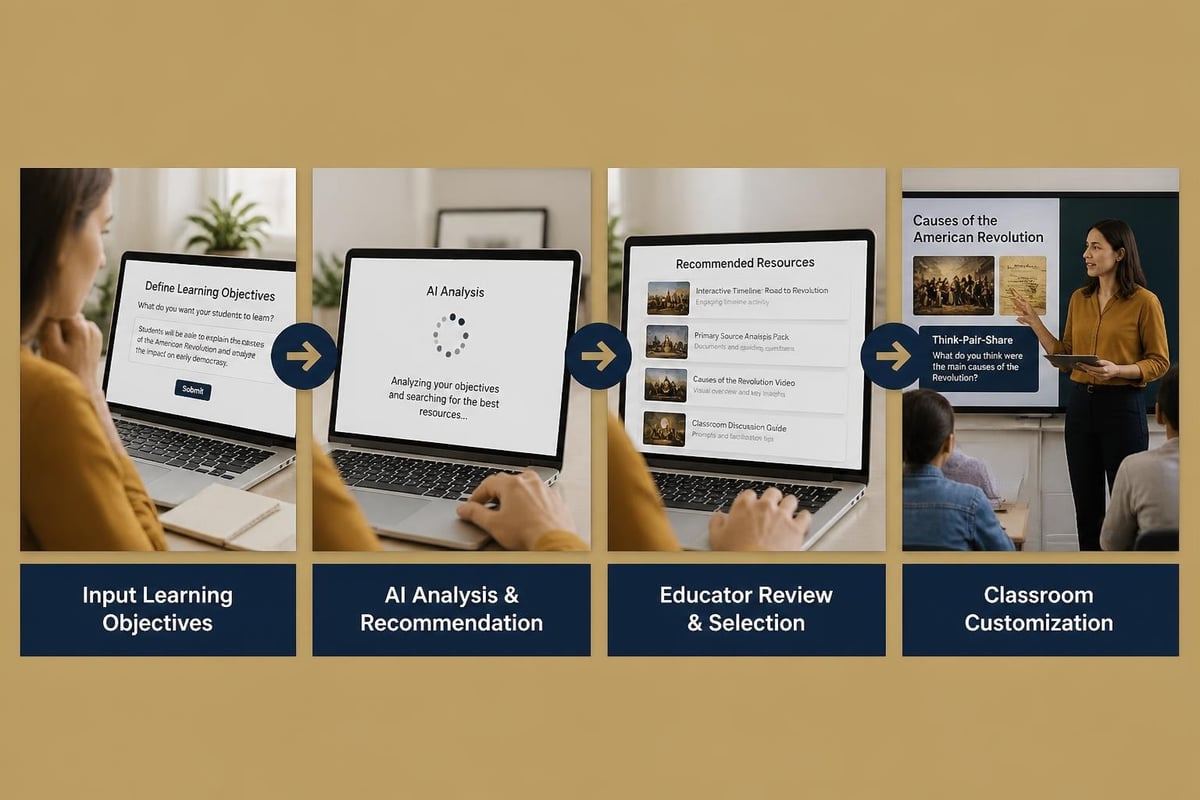
Educators integrate AI throughout their resource workflow, from initial discovery through implementation and assessment. AI-powered search engines understand educational context better than general search tools, filtering results by pedagogical approach, accessibility requirements, and alignment to specific standards frameworks.
Smart educators also use AI for resource organization and curation. Digital assistants tag and categorize saved materials, making retrieval effortless when planning future units. Some systems analyze teaching schedules and proactively suggest relevant free teaching resources before educators begin planning, anticipating needs based on curriculum pacing guides.
Professional development in AI literacy has become essential for maximizing these tools' potential. The
AI Literacy Certification for Educators program helps teachers develop practical skills for lesson planning, prompt engineering, and ethical AI integration, ensuring they confidently leverage AI-enhanced resources while maintaining pedagogical control and professional judgment.
Not all free teaching resources deliver equal instructional value. Educators must develop critical evaluation skills to distinguish high-quality materials from those requiring substantial revision or replacement.
Professional evaluation begins with standards alignment verification. Resources should explicitly connect to relevant learning standards, whether Common Core, Next Generation Science Standards, state frameworks, or subject-specific guidelines. The strongest materials include standards mappings and learning objective statements that clarify exactly what students will know and be able to do.
Pedagogical soundness represents another critical dimension. Quality resources reflect current research on how students learn, incorporating evidence-based practices like scaffolded instruction, formative assessment opportunities, and differentiation suggestions. Materials should guide teachers through implementation with clear instructions rather than assuming extensive content expertise.
Essential evaluation criteria include:
- Accuracy: Content reflects current knowledge and corrects common misconceptions
- Accessibility: Materials support diverse learners including those with disabilities
- Cultural responsiveness: Resources represent diverse perspectives and avoid stereotypes
- Engagement: Activities capture student interest and maintain attention
- Flexibility: Materials adapt to various classroom contexts and teaching styles
- Support: Teacher guides provide implementation guidance and troubleshooting
Albany State University emphasizes these evaluation dimensions when guiding faculty toward quality OER, recognizing that adoption success depends on thorough vetting before classroom implementation.
The strongest indicator of resource quality often comes from fellow educators who have implemented materials in real classrooms. Platforms incorporating user ratings, reviews, and implementation stories provide invaluable peer validation that supplements official quality markers.
Active participation in professional learning communities, whether online forums or local teacher networks, accelerates quality resource discovery. Educators share successes, warn about problematic materials, and collaborate on improvements to promising but imperfect resources. This collective intelligence surpasses any individual's capacity for comprehensive evaluation.
| Evaluation Method |
Strengths |
Limitations |
| Standards alignment check |
Objective, verifiable |
Doesn't assess engagement or effectiveness |
| Peer reviews |
Real classroom experience |
Variable reviewer expertise |
| Pilot implementation |
Direct evidence |
Time-intensive |
| Research citations |
Evidence-based foundation |
May not reflect classroom reality |
| Student feedback |
End-user perspective |
Requires initial implementation
|
Accumulating free teaching resources without organization systems creates digital clutter that undermines efficiency. Strategic collection management ensures materials remain accessible when needed most.
Cloud-based filing systems allow educators to access resources from any device while maintaining consistent organization. Folder structures should mirror curriculum organization, whether by unit, standard, or learning objective. Consistent naming conventions enable quick searching and prevent duplicate downloads.
Tagging systems add multidimensional organization beyond hierarchical folders. Tags for difficulty level, activity type, technology requirements, and time estimates help teachers quickly locate materials matching specific needs. Many educators maintain spreadsheet inventories cataloging their resource collections with clickable links and brief descriptions.
Effective organizational approaches:
- Create a main resource hub using cloud storage or bookmarking tools
- Develop consistent naming conventions including date, topic, and resource type
- Tag resources with multiple descriptors for flexible retrieval
- Schedule quarterly reviews to remove outdated or unused materials
- Share organized collections with department colleagues for collaborative benefit
The
Mathematics Authority guide to public mathematics education resources demonstrates how systematic organization transforms scattered materials into coherent instructional systems supporting curriculum implementation.

While general repositories serve broad needs, subject-specific platforms often provide superior depth and pedagogical expertise for particular disciplines.
Mathematics educators benefit from specialized platforms offering interactive manipulatives, problem banks, and concept demonstrations. Beyond Khan Academy, resources like Desmos provides free graphing calculators and classroom activities built around mathematical modeling. PhET Interactive Simulations from University of Colorado Boulder offers research-based science and math simulations that make abstract concepts tangible.
GeoGebra combines geometry, algebra, and calculus tools in one platform, supporting exploration-based mathematics learning. The National Library of Virtual Manipulatives provides interactive, web-based manipulatives for K-12 mathematics instruction across number operations, algebra, geometry, measurement, and data analysis.
Literature and history teachers access vast primary source collections through institutional archives and government repositories. The Library of Congress offers millions of digitized documents, photographs, maps, and multimedia resources documenting American history and culture. The National Archives provides lesson-ready document sets with teaching guides and analysis tools.
For current events integration, NewsELA and PBS LearningMedia offer free accounts providing leveled news articles, primary sources, and multimedia resources aligned to standards. These platforms adjust reading levels while maintaining content integrity, supporting differentiated instruction within heterogeneous classrooms.
The most sustainable approach to free teaching resources involves collaborative creation and sharing among educator communities. When teachers contribute to collective repositories, everyone benefits from expanded material diversity and reduced individual workload.
Online communities like Teachers Pay Teachers (which includes free sections), Share My Lesson, and Facebook teaching groups facilitate resource exchange among millions of educators worldwide. While some platforms include commercial elements, substantial free sections provide quality materials without cost.
Local professional learning communities within schools and districts enable contextually relevant resource sharing. When teachers at the same school create and share materials, they ensure alignment with adopted curricula, school-wide initiatives, and shared student populations. This localized collaboration often proves more immediately valuable than general internet searches.
Benefits of collaborative resource ecosystems:
- Reduced individual preparation time through shared workload
- Diverse perspectives improving resource quality and inclusivity
- Faster identification and correction of errors or limitations
- Professional learning through examining colleagues' instructional approaches
- Sustainable systems that outlast individual teacher turnover
Dakota State University emphasizes collaborative approaches to OER adoption, recognizing that faculty communities working together achieve better outcomes than isolated individual efforts.
Understanding copyright and licensing ensures educators use free teaching resources legally and ethically. Not all free materials carry permissions for educational use, and proper attribution protects both teachers and content creators.
Creative Commons licenses provide standardized frameworks indicating exactly what users may do with resources. The six main Creative Commons licenses range from highly permissive (allowing any use with attribution) to restrictive (allowing only unmodified redistribution). Educators should verify licensing before adapting or sharing materials.
Public domain resources carry no copyright restrictions, making them freely usable for any purpose. Works published before 1928 generally fall into public domain, as do federal government publications. However, state and local government materials may carry copyright, requiring permission verification.
Key licensing practices include:
- Always check licensing information before using or sharing resources
- Provide proper attribution as specified in license terms
- Respect restrictions on commercial use or derivative works
- Teach students about copyright through modeling ethical resource use
- Document permissions when contacting creators for special uses
Fair use doctrine provides limited exceptions for educational purposes, but relying solely on fair use creates legal uncertainty. When excellent openly licensed alternatives exist, choosing those materials eliminates risk while supporting the broader OER movement.
The landscape of free teaching resources continues evolving as technology advances and educational priorities shift. Understanding emerging trends helps educators prepare for future resource environments and advocate for policies supporting continued access.
Augmented and virtual reality resources are becoming increasingly accessible, offering immersive learning experiences previously requiring expensive hardware. Platforms like Google Expeditions (now part of Google Arts & Culture) provide virtual field trips to museums, historical sites, and natural wonders worldwide. These technologies democratize experiences that geography and funding previously placed beyond reach.
Adaptive learning platforms using sophisticated algorithms personalize instruction based on individual student performance. While many adaptive systems require subscriptions, growing numbers of free options provide basic personalization features that differentiate instruction at scale. These tools complement teacher expertise rather than replacing it, handling routine practice while freeing educators for higher-value interactions.
Artificial intelligence continues expanding its role in both resource creation and customization. As AI literacy becomes standard professional competency, educators will increasingly generate custom materials rather than searching for pre-made resources. The
Hadary Institute blog explores these developments, helping educators stay current with AI's educational applications.
Continued access to quality free teaching resources requires supportive policies at institutional, state, and federal levels. Educators can advocate for OER adoption policies, funding for resource development, and infrastructure supporting digital access.
Some states now require consideration of OER alternatives before traditional textbook purchases, saving taxpayer money while improving resource quality. Federal grant programs increasingly prioritize openly licensed deliverables, expanding the commons of available materials. Professional organizations play crucial roles advocating for these policies while providing platforms for resource sharing.
Equitable access remains paramount as resources shift increasingly digital. Advocacy must address connectivity gaps, device availability, and digital literacy barriers that prevent some students from accessing online free teaching resources. The best materials serve all learners, not just those with reliable internet and current technology.
Free teaching resources have transformed from supplementary materials to core instructional assets that empower educators while reducing costs and expanding access. By mastering discovery, evaluation, and organization strategies, teachers build sustainable resource ecosystems supporting excellent instruction. Hadary Institute prepares educators for this evolving landscape through professional certification that develops practical AI skills for lesson planning, resource creation, and ethical educational technology integration, ensuring teachers confidently leverage both traditional and emerging free resources to maximize student learning.