Future Readiness Skills: Preparing Educators for 2026
Aug 8
/
Islam ElHadary
The educational landscape has undergone unprecedented transformation over the past decade, and 2026 finds us at a critical juncture where traditional teaching methods intersect with artificial intelligence capabilities.
Educators who once focused solely on subject matter expertise now recognize that their professional development must extend far beyond content knowledge. The competencies required to thrive in today's classrooms encompass a sophisticated blend of human-centered abilities and technological fluency.
These future readiness skills represent not just an enhancement to existing teaching practices but a fundamental reconceptualization of what it means to be an effective educator in an AI-augmented world.
Educators who once focused solely on subject matter expertise now recognize that their professional development must extend far beyond content knowledge. The competencies required to thrive in today's classrooms encompass a sophisticated blend of human-centered abilities and technological fluency.
These future readiness skills represent not just an enhancement to existing teaching practices but a fundamental reconceptualization of what it means to be an effective educator in an AI-augmented world.
Understanding Future Readiness Skills in Education
Future readiness skills encompass the competencies, mindsets, and capabilities that enable educators to navigate constant change, leverage emerging technologies, and prepare students for careers that may not yet exist. Unlike static skill sets that remain relevant for decades, these competencies prioritize adaptability and continuous learning as core principles.
The concept extends well beyond basic digital literacy. While familiarity with technology tools remains important, true future readiness requires educators to develop sophisticated judgment about when and how to integrate AI into their practice. The Futures Readiness framework emphasizes this integration of traditional competencies with AI-specific capabilities, creating a comprehensive approach to professional development.
The Three Pillars of Educator Future Readiness
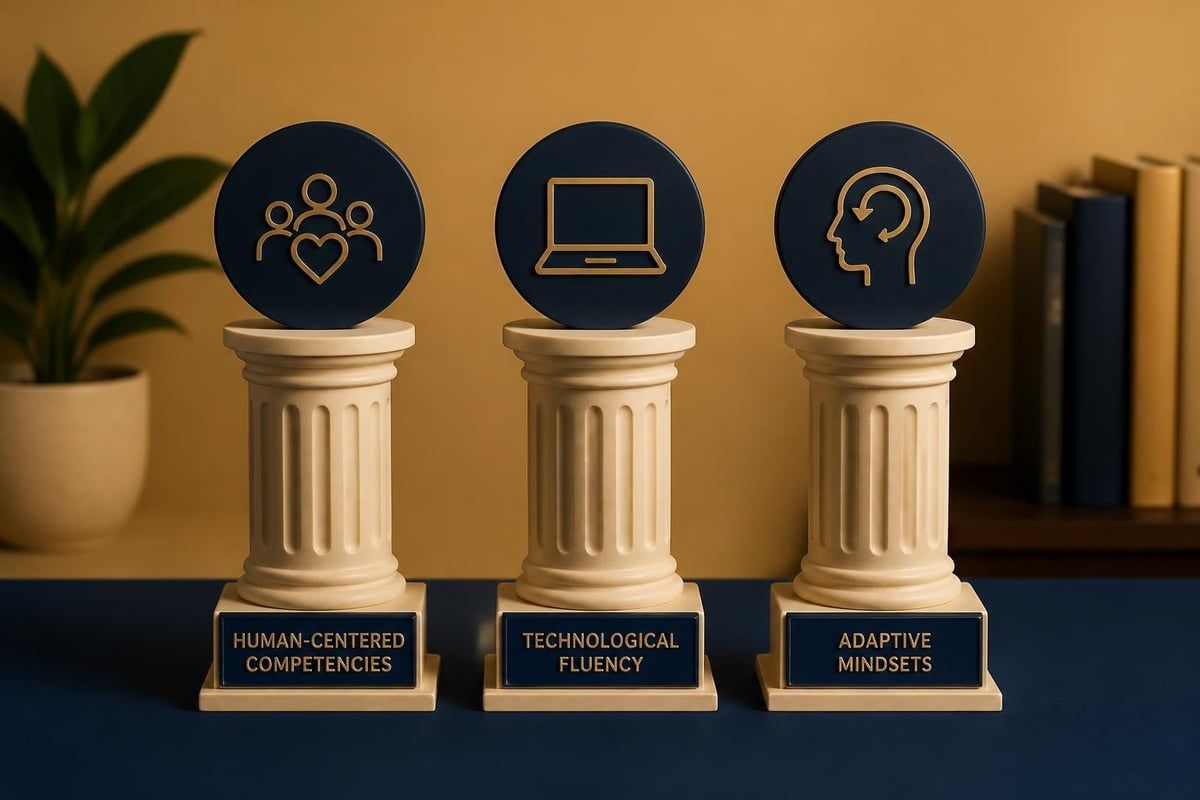
Educational future readiness rests on three interconnected foundations that support effective teaching in 2026:
Human-Centered Competencies
- Emotional intelligence and empathy
- Ethical reasoning and values-based decision making
- Creative problem solving and innovation
- Complex communication across diverse audiences
- Collaborative leadership in multidisciplinary teams
Technological Fluency
- AI literacy and prompt engineering
- Data interpretation and critical evaluation
- Platform navigation and tool selection
- Digital safety and privacy awareness
- Algorithmic bias recognition
Adaptive Mindsets
- Comfort with ambiguity and uncertainty
- Growth-oriented learning approaches
- Resilience in the face of rapid change
- Curiosity-driven exploration
- Systems thinking and interconnected reasoning
These pillars work synergistically rather than in isolation. An educator who develops AI literacy without ethical reasoning may integrate technology in ways that harm student outcomes. Conversely, strong human-centered skills without technological fluency leave teachers unprepared to leverage the tools reshaping education.
Critical Thinking and Information Evaluation
The proliferation of AI-generated content has fundamentally altered how educators must approach information literacy. In 2026, students can access sophisticated AI tools that produce convincing but potentially inaccurate content within seconds. This reality demands that teachers develop advanced critical thinking capabilities to model and teach effective evaluation strategies.
Future readiness skills in this domain include the ability to question sources, identify algorithmic bias, and distinguish between correlation and causation in data-driven claims. Educators must become expert navigators of an information ecosystem where AI can generate thousands of plausible-sounding responses that may or may not align with factual accuracy.
Teaching Students to Think Critically About AI Outputs
Consider the practical application in a classroom setting. When a student submits work potentially created by generative AI, an educator with strong future readiness skills doesn't simply run it through a detection tool. Instead, they engage the student in metacognitive dialogue about the creation process, ask probing questions that reveal understanding, and design assessments that value original thinking over polished final products.
This approach requires teachers to develop what the DQ Institute identifies as essential future-readiness competencies: digital intelligence that combines critical thinking with ethical awareness. The skill extends beyond detecting AI usage to fostering environments where students value authentic learning over shortcut outputs.
| Critical Thinking Application | Traditional Approach | Future-Ready Approach |
| Source evaluation | Check publication date and author credentials | Analyze algorithmic curation, funding sources, and potential AI generation |
| Research assignments | Require specific number of sources | Focus on synthesis, analysis, and original argumentation regardless of source count |
| Information literacy | Teach library database navigation | Include AI tool evaluation, prompt refinement, and output verification |
| Assessment design | Test recall and comprehension | Emphasize application, creation, and metacognitive reflection |
Adaptability and Continuous Learning
The half-life of technical skills continues to shrink across all industries, and education faces particularly acute pressure to evolve. Tools that seemed cutting-edge six months ago may become obsolete or integrated into larger platforms by year's end. This rapid pace of change makes adaptability one of the most crucial future readiness skills for educators.
Adaptability manifests in multiple dimensions of teaching practice. At the tactical level, it means quickly learning new platforms and adjusting lesson plans when technology fails or produces unexpected results. Strategically, it requires remaining open to pedagogical shifts as research reveals more effective approaches to AI integration.
The Stifterverband's Future Skills Framework identifies 30 specific competencies across five categories, emphasizing that future readiness requires both breadth and depth. Educators need specialized technical knowledge alongside transferable capabilities like learning agility and reflective practice.
Building a Continuous Learning Practice
Establishing sustainable professional development habits separates educators who maintain future readiness from those who struggle to keep pace. Effective continuous learning doesn't require hours of daily study but instead integrates micro-learning opportunities into existing workflows.
- Weekly experimentation sessions: Dedicate 30 minutes each week to exploring a new AI tool or feature relevant to your teaching context
- Peer learning communities: Join or establish groups where educators share discoveries, challenges, and solutions related to AI integration
- Reflective documentation: Maintain a teaching journal that captures what works, what fails, and why, creating a personal knowledge base
- Strategic skill stacking: Build new capabilities on existing strengths rather than starting from scratch in completely unfamiliar domains
- Failure normalization: Treat unsuccessful experiments as valuable data points rather than setbacks
The AI Literacy Certification for Educators program addresses this need by providing structured yet flexible learning pathways. Rather than overwhelming teachers with every possible AI application, it focuses on practical skills that transfer across multiple teaching contexts. Participants learn to design AI-assisted teaching activities that enhance rather than replace human instruction, gaining reusable prompt templates and frameworks that support ongoing experimentation.

Ethical Reasoning in AI-Enhanced Education
As AI tools become increasingly sophisticated and accessible, educators face complex ethical questions daily. Should students be allowed to use AI for brainstorming? How much AI assistance crosses the line into academic dishonesty? What privacy protections must be in place when using platforms that collect student data? These questions don't have universal answers, making ethical reasoning a cornerstone of future readiness skills.
Developing strong ethical frameworks requires educators to engage with multiple perspectives on AI in education. Some argue that prohibiting AI usage prepares students poorly for workplaces where these tools are standard. Others contend that over-reliance on AI during formative years stunts critical skill development. Navigating these tensions demands sophisticated judgment rather than rigid rules.
Frameworks for Ethical AI Integration
Several practical frameworks help educators make consistent, values-aligned decisions about AI integration:
- The Purpose Test: Does this AI application serve clear educational objectives that benefit student learning outcomes?
- The Transparency Standard: Are students aware when they're interacting with AI, and do they understand how it functions?
- The Equity Lens: Does this tool's implementation maintain or worsen existing achievement gaps and access disparities?
- The Privacy Threshold: What student data does this tool collect, who owns it, and how might it be used beyond the immediate educational context?
- The Development Balance: Does AI usage support or undermine students' development of essential human capabilities?
Applying these frameworks in real time requires practice and reflection. An educator with well-developed future readiness skills might initially approve an AI tool that seems beneficial, then reconsider after observing how students interact with it. This iterative ethical reasoning, where teachers continuously evaluate and adjust their practices, represents mature professional judgment.
Research on measuring adaptability and resilience highlights how these competencies increasingly matter for professional success. Educators who model ethical reasoning about AI teach students valuable decision-making frameworks that transfer far beyond classroom contexts.
Collaboration and Communication in Hybrid Environments
The notion of a teacher working in isolation has become increasingly obsolete. Effective 2026 educators collaborate across disciplines, grade levels, and even institutions to share resources, solve problems, and innovate approaches to AI integration. These collaborative practices require specific future readiness skills distinct from traditional teamwork.
Digital collaboration tools enable real-time co-creation of curriculum materials, shared prompt libraries, and collective troubleshooting when AI tools produce unexpected results. However, these same tools can create communication overload, unclear ownership of ideas, and coordination challenges across different time zones and schedules.
Effective Collaboration Strategies
Synchronous Collaboration Best Practices
- Establish clear meeting objectives before gathering
- Use collaborative documents to maintain focus and capture decisions
- Designate rotating facilitation roles to distribute leadership
- Time-box discussions to prevent endless deliberation
- Create explicit action items with ownership and deadlines
Asynchronous Collaboration Techniques
- Document context thoroughly so others can contribute without real-time explanation
- Use threaded discussions to maintain topic organization
- Establish response time expectations to prevent bottlenecks
- Create living documents that evolve rather than requiring meeting approvals for every change
- Celebrate and attribute contributions to build collaborative culture
The communication dimension of future readiness skills extends to how educators interact with students, families, and administrators about AI integration. Explaining why certain AI tools are embraced while others are prohibited requires clear articulation of pedagogical reasoning. Addressing parent concerns about screen time and AI dependence demands empathy combined with evidence-based perspective.
| Stakeholder | Communication Challenge | Future-Ready Approach |
| Students | Understanding AI boundaries and expectations | Co-create usage guidelines that reflect learning objectives |
| Parents | Concerns about technology dependence | Share specific examples of how AI enhances rather than replaces learning |
| Administrators | Budget justification for AI tools | Present data on time savings, engagement metrics, and learning outcomes |
| Colleagues | Resistance to change | Offer low-stakes experimentation opportunities and share both successes and failures |
Creative Problem Solving with AI as a Partner
One of the most transformative aspects of AI in education involves its potential as a creative partner rather than mere efficiency tool. Educators with advanced future readiness skills recognize that AI can help generate ideas, explore possibilities, and iterate on solutions in ways that amplify human creativity rather than replace it.
This partnership approach requires reframing how teachers think about lesson planning, assessment design, and student support. Instead of viewing AI as a threat to authentic teaching, future-ready educators see it as a collaborative tool that handles routine cognitive tasks while freeing mental energy for higher-order thinking and personalized student interaction.
Practical Applications of AI-Augmented Creativity
Consider differentiation, a perennial challenge in diverse classrooms. A future-ready educator might use AI to quickly generate multiple versions of a reading passage at different complexity levels, then apply professional judgment to refine these outputs based on specific student needs. The AI handles the time-consuming initial creation, while the teacher contributes irreplaceable expertise about individual learners.
Similarly, when designing project-based learning experiences, AI can help brainstorm authentic real-world connections, suggest assessment rubrics, or identify potential obstacles students might encounter. The educator evaluates these suggestions through the lens of their classroom context, student interests, and learning objectives.
The FutureFit Academy emphasizes skills like curiosity and tolerance of ambiguity as essential preparation for uncertain futures. These capabilities prove particularly valuable when working with AI, which often produces unexpected or imperfect outputs that require creative adaptation rather than simple acceptance or rejection.

Data Literacy and Evidence-Based Practice
Modern educational technology generates unprecedented amounts of data about student engagement, comprehension, and progress. Future readiness skills include the ability to interpret this data critically, identify meaningful patterns, and make evidence-informed instructional decisions without becoming overwhelmed by metrics.
The challenge lies not in accessing data but in determining which data matters and how to act on it. AI-powered platforms can track dozens of variables, from time spent on tasks to specific error patterns to engagement fluctuations throughout a lesson. An educator with strong data literacy distinguishes between correlation and causation, recognizes when sample sizes are too small for reliable conclusions, and balances quantitative metrics with qualitative observations.
From Data Collection to Actionable Insights
The transformation of raw data into improved teaching practice requires several steps:
- Clarify questions: Begin with specific instructional questions rather than examining all available data
- Select relevant metrics: Choose measurements that directly relate to your questions
- Analyze patterns: Look for trends across time, student groups, or teaching strategies
- Generate hypotheses: Develop potential explanations for observed patterns
- Test interventions: Make targeted changes and monitor their impact
- Iterate and refine: Adjust approaches based on results and continue the cycle
This systematic approach prevents both data overload and unfounded conclusions. Teachers who have developed these future readiness skills can leverage AI-generated analytics without becoming enslaved to metrics that may not reflect meaningful learning.
Professional learning communities benefit enormously when educators share not just successful practices but the data that informed their decisions. This transparency helps colleagues understand the context in which strategies proved effective and adapt approaches to their own situations rather than implementing cookie-cutter solutions.
Self-Direction and Autonomous Learning
The rapid evolution of AI tools means that formal professional development often lags behind current capabilities. Educators who wait for district-provided training may find themselves perpetually behind the curve. Self-directed learning has become one of the most valuable future readiness skills, enabling teachers to proactively explore emerging tools and techniques.
Autonomous learning doesn't mean working in isolation or reinventing every wheel. Effective self-directed educators curate information sources, identify trusted experts, and build personal learning networks that expose them to diverse perspectives and innovations. They develop systems for evaluating new tools quickly, determining which merit deeper exploration and which can be safely ignored.
The distinction between productive self-direction and overwhelming yourself with every new development requires metacognitive awareness. Future-ready educators recognize their learning preferences, acknowledge their limitations, and strategically choose which competencies to develop based on their teaching context and professional goals.
Building Sustainable Self-Directed Learning Habits
- Curate quality sources: Follow 3-5 educators or organizations whose AI education insights consistently prove valuable rather than subscribing to dozens of newsletters you never read
- Schedule exploration time: Block dedicated calendar time for professional learning rather than hoping to fit it into spare moments
- Set specific learning goals: Target particular skills or tools rather than vague intentions to "stay current"
- Document your learning: Keep notes on what you discover, even brief ones, to reinforce retention and create future reference materials
- Share your discoveries: Teaching others what you've learned deepens your own understanding and builds community
Resources like those available through Hadary Institute's blog provide structured starting points for self-directed exploration. However, the key to sustainable autonomous learning lies in developing your own system that matches your schedule, learning style, and professional priorities.
Designing Future-Ready Professional Development
Individual educator growth matters tremendously, but systemic change requires institutional support for developing future readiness skills across entire school communities. Administrators and instructional leaders face the challenge of designing professional development that builds genuine capability rather than superficial familiarity.
School and district leaders who invest in developing these future readiness skills across their teams create cultural shifts that extend far beyond individual classrooms. When educators regularly discuss AI integration, share prompt libraries, and collaboratively solve implementation challenges, the entire organization builds capacity to navigate technological change.
Effective PD in this domain moves beyond one-time workshops toward sustained learning experiences that include application, reflection, collaboration, and iteration. Teachers need opportunities to experiment with AI tools in low-stakes environments, share failures alongside successes, and receive coaching as they integrate new practices into their teaching.
The most successful programs recognize that educators enter with vastly different baseline knowledge and comfort levels with technology. Differentiated professional learning pathways allow teachers to engage at appropriate challenge levels while maintaining common goals and shared language around AI integration.
| Traditional PD Model | Future-Ready PD Model |
| One-time workshop or presentation | Ongoing learning community with multiple touchpoints |
| Expert demonstrates tool usage | Educators experiment and share discoveries |
| Focus on technical features | Emphasis on pedagogical applications and ethical considerations |
| Identical experience for all participants | Differentiated pathways based on readiness and goals |
| Evaluation based on satisfaction surveys | Assessment through evidence of classroom implementation |
| Separate from daily teaching practice | Embedded in planning time and collaborative work |
School and district leaders who invest in developing these future readiness skills across their teams create cultural shifts that extend far beyond individual classrooms. When educators regularly discuss AI integration, share prompt libraries, and collaboratively solve implementation challenges, the entire organization builds capacity to navigate technological change.
The Role of Emotional Intelligence
Technical competencies alone prove insufficient for navigating the human dimensions of AI integration in education. Future readiness skills must include high levels of emotional intelligence to address student anxiety about AI, colleague resistance to change, and personal feelings of inadequacy when confronting unfamiliar technologies.
Educators encounter students who feel threatened by AI's capabilities, wondering if their writing or analytical skills have value when machines can perform similar tasks. Others may become overly dependent on AI assistance, avoiding cognitive challenges that build essential capabilities. Addressing these responses requires empathy, perspective-taking, and the ability to have nuanced conversations about technology's role in learning and life.
Similarly, when working with colleagues at different points on the AI adoption curve, emotional intelligence enables productive dialogue rather than judgment. The teacher who eagerly embraces every new tool and the one who remains skeptical of AI's educational value both bring valid perspectives. Future-ready educators create space for these different viewpoints while moving conversations toward evidence-based decision-making.
Self-awareness represents another critical component of emotional intelligence in this context. Recognizing when your own discomfort with AI stems from legitimate pedagogical concerns versus general resistance to change allows for more honest self-assessment and targeted skill development. Acknowledging uncertainty rather than projecting false confidence builds trust with students and colleagues navigating similar challenges.
The future readiness skills outlined here represent both an opportunity and a responsibility for educators in 2026. As AI continues reshaping educational landscapes, the teachers who develop sophisticated competencies across technical, ethical, and human dimensions will be best positioned to serve their students effectively. These capabilities aren't developed overnight but through sustained practice, reflection, and commitment to continuous growth. Hadary Institute provides educators with structured pathways to build AI literacy and integration skills through practical, hands-on learning experiences designed specifically for teaching contexts. Whether you're taking your first steps with AI tools or looking to deepen existing capabilities, investing in these future readiness skills ensures you remain effective and relevant in an ever-evolving educational landscape.

Commercial Representative - OpenSemsem Ltd.
128 City Road, London EC1V 2NX, United Kingdom
Phone number: +44 750 2843 500
128 City Road, London EC1V 2NX, United Kingdom
Phone number: +44 750 2843 500
Copyright © 2026
Created with
