That single fact should stop us for a second. The institutions that give the whole of humanity its chance to work, to manage, to eat, to feed a family, to grow, and to raise the next generation are themselves run by someone. Which means the management of these "humanity factories" is not a neutral, background detail — it is one of the most consequential jobs on Earth, and it can be either a blessing or a curse for everyone who comes after it.
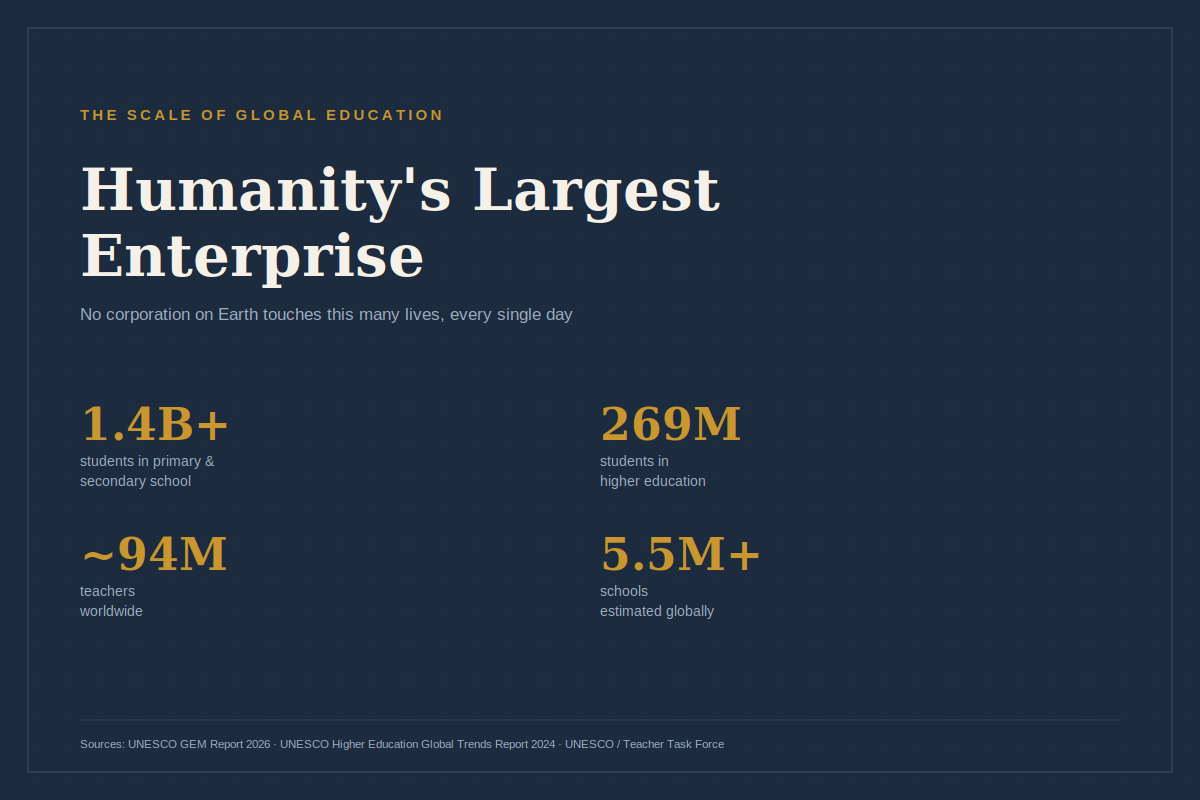
Business leadership gets the books, the case studies, the conference stages. Education leadership — arguably managing something larger, and certainly something more permanent in its effects — gets far less attention. The numbers make the imbalance strange:
| Global education, by the numbers |
Figure |
Source |
| Students in primary & secondary school |
1.4 billion+ |
UNESCO Global Education Monitoring Report, 2026 |
| Students in higher education |
269 million |
UNESCO Higher Education Global Trends Report, 2024 |
| Teachers worldwide |
~94 million |
UNESCO / Teacher Task Force, 2019 |
| Universities & colleges |
~50,000 |
Global higher-education counts, 2025 |
| Schools (all levels) |
5.5 million+ (estimated) |
UNESCO Institute for Statistics, estimate |
That last row deserves an honest caveat: nobody actually knows the exact number of schools on Earth. Estimates from UNESCO, the World Bank, and independent researchers range from just over a million to more than ten million, depending on what counts as a "school" and which countries report data at all. But even the most conservative estimate describes an enterprise larger than any corporation that has ever existed. No company — not the biggest retailer, the biggest bank, the biggest technology platform — touches this many lives, every single day, at the exact moment those lives are being formed.
Here is where the job stops resembling any other kind of leadership.
A corporate leader can say: "This is our policy, our way of managing quality — to be one of us, follow it, or leave." A defective product can be checked, analyzed, and fixed accordingly. That is a luxury. Any corporate leader can point at a flaw, name it a defect, and correct it — a luxury a dean, a rector, or a head of school does not have when they're meeting a new idea, a challenge to a long-held theory, or a disagreement over how a lesson should be delivered.
You cannot recall a child. You cannot issue a refund on a semester. You cannot A/B test a teenager's education and just ship the winning variant. Every "defect" in an education system has a name, a family, and a future — which means the entire logic of corporate quality control breaks down the moment you try to apply it to a classroom.
A few more places where the two jobs quietly diverge:
- Rebranding. A company can reposition its entire brand identity overnight with a new campaign. A university's mission is a generational commitment — change it too fast, and you break the trust of alumni, faculty, and the community all at once.
- The product recall. A faulty batch gets pulled from shelves and the cost is contained. A weak curriculum graduates an entire cohort before anyone fully sees the damage — and there is no recall notice you can send to the world these graduates now have to navigate.
- The underperformer. A company can quietly manage out an employee who isn't meeting the bar. A struggling student is the reason the institution exists. There is no off-boarding a ninth grader.
- The pivot. A startup can pivot its entire strategy in a single board meeting. A new teaching method needs years of piloting, buy-in, accreditation, and trust before it can responsibly reach a single classroom.
- The metric. A quarter is the natural unit of corporate success. A career — the one a graduate builds over the next forty years — is the natural unit of educational success. You will not know if you did your job well for decades.
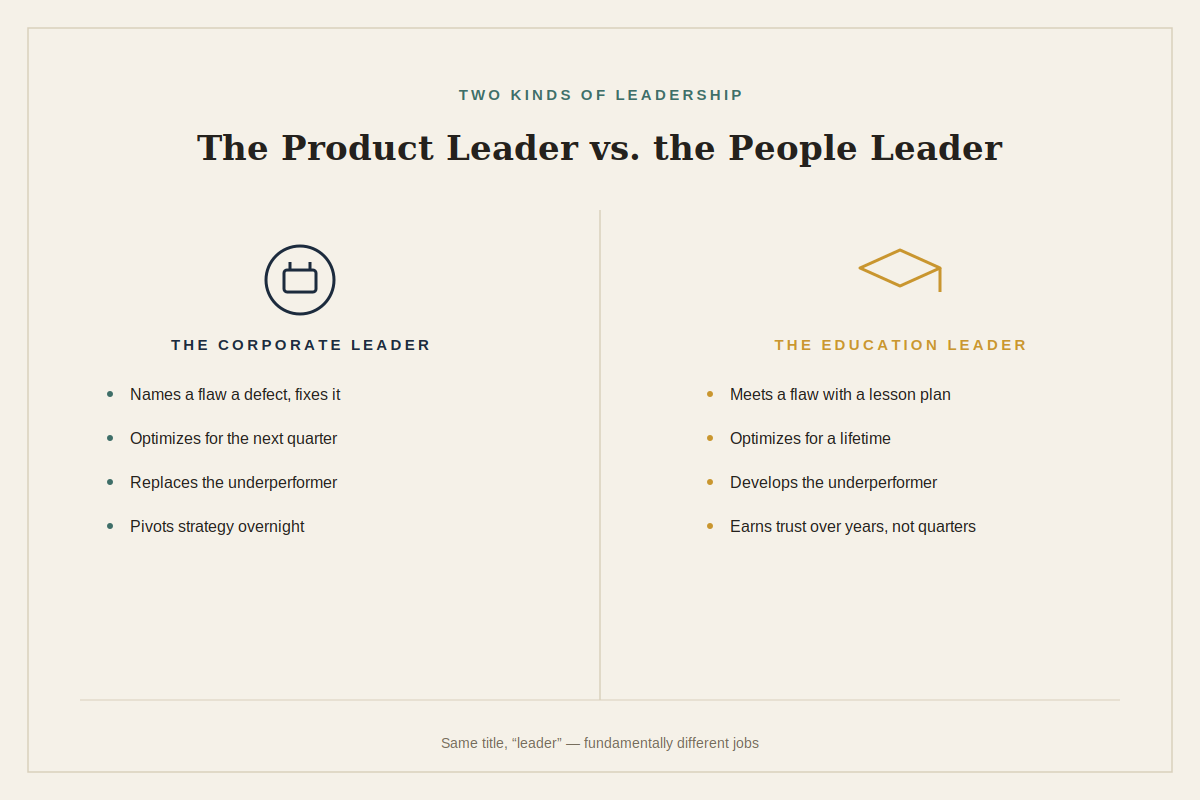
As one analysis of school leadership put it, the role differs from corporate leadership because schools exist primarily to develop people rather than produce products — the institution's purpose is human development itself, not a deliverable.
Every leadership role demands vision, discipline, and the ability to make hard calls under uncertainty. But the traits that make someone excellent look different once the "product" is a human being instead of a quarterly result.
| Trait |
The Corporate Leader |
The Education Leader |
| Time horizon |
Quarters and fiscal years |
Careers and generations |
| Definition of a "defect" |
A flaw to isolate and fix |
A person to understand and develop |
| Primary stakeholder |
Shareholders and customers |
Students, parents, teachers, and the community — often all at once, often in conflict |
| Tolerance for ambiguity |
Resolve fast, decide, move on |
Sit with unresolved pedagogical and ethical questions for years |
| Accountability |
Measured in revenue, market share, retention |
Measured in outcomes that surface long after the leader has moved on |
| Cost of a mistake |
Contained, often reversible |
Compounds across a young person's whole trajectory |
| What "innovation" requires |
Speed and a willing market |
Consensus, evidence, and the trust of people responsible for a child |
Martin Luther King Jr. put the underlying stakes plainly: "Intelligence plus character — that is the goal of true education." An education leader isn't just optimizing a system; they're responsible for both halves of that equation, at scale, for people who had no say in choosing them as their leader.
Simon Sinek's line about leadership applies here with unusual precision, since a school leader's job really is about taking care of those in their charge — not managing them toward a number, but building the conditions where a teacher can teach well and a student can actually learn.
Go back to the scale for a second: 1.6 billion students. 94 million teachers. Every one of them shaped, for better or worse, by how well the person at the top of their institution understood the difference between running an organization and stewarding people. Nelson Mandela's most quoted line exists for a reason — "Education is the most powerful weapon which you can use to change the world" — but a weapon that powerful is only ever as good as the hand holding it.
That's the real argument for taking education leadership as seriously as we take corporate leadership, maybe more seriously. The institutions producing the next generation of every profession, every government, every company on Earth deserve leaders who are equipped for a job that has almost nothing in common with the leadership playbooks written for anywhere else.
None of this is meant to diminish the leaders of other kinds of entities. It's mainly a reminder — to myself, and to every leader responsible for an educational institute — that the risk embedded in the consequences of each and every decision we make is very high.
We have to stay open to new ideas, and to listening to everyone in the institute. But that openness has to come paired with discipline: calculating the effects of a decision as fully as we can before we make it, and then sharing, as openly as possible, the reasoning behind every decision we accept or reject — with everyone it touches.
This is also, honestly, why the tools available to educators and education leaders matter so much right now. AI won't resolve the fundamental difference between managing a product and developing a person — nothing will, and it shouldn't. But used well, it can hand back some of the time and capacity that thoughtful, human-centered education leadership has always demanded and rarely had enough of.
Most importantly to stay human.
Sources- UNESCO, 2026 Global Education Monitoring Report
- UNESCO, Number of students in higher education more than doubled in 20 years
- UNESCO / Teacher Task Force, Data on teachers
- UNESCO Institute for Statistics, school-count estimates (via History Tools)